st

Showing posts with label ISC. Show all posts

Monday, August 25, 2025

Find ∫ [ √(tan x ) + √(cot x) ]dx step by step

 Find ∫ [ √(tan x ) + √(cot x) ]dx


more explanation in the video


Evaluate the indefinite integral

∫ [ √(tan x) + √(cot x) ] dx

Strategy overview
The most efficient route is to express tangent and cotangent through sine and cosine, then search for a substitution that treats the two square roots in a symmetric way. A natural attempt is to combine sine and cosine linearly because sin x and cos x appear in reciprocal fashion inside tan x and cot x. The expression sin x minus cos x is the key. With that choice you can leverage the identity for sin 2x and a compact derivative that collapses a messy sum into a familiar primitive.

Detailed solution
Start by rewriting the integrand through sine and cosine. Write tan x as sin x over cos x. Write cot x as cos x over sin x. Then the integrand becomes

√(sin x over cos x) + √(cos x over sin x)

This is

(√sin x over √cos x) + (√cos x over √sin x)

Now bring the two terms over a common style of denominator by noting that

(√sin x over √cos x) + (√cos x over √sin x)
equals
( sin x + cos x ) divided by √(sin x cos x)

To see that, write each fraction with denominator √(sin x cos x). The first term becomes sin x divided by √(sin x cos x). The second term becomes cos x divided by √(sin x cos x). Summing yields the expression above. The integrand is now

( sin x + cos x ) / √( sin x cos x )

This is a big step because it reduces the pair of nested roots to a single root. Next recall that sin 2x equals 2 sin x cos x. Thus sin x cos x equals sin 2x over 2. The denominator becomes √( sin 2x over 2 ). That is √(sin 2x) over √2. Therefore the integrand becomes

( sin x + cos x ) divided by ( √(sin 2x) over √2 )
which equals
√2 ( sin x + cos x ) / √( sin 2x )

You want to introduce a substitution whose derivative matches sin x plus cos x. Observe that the derivative of sin x minus cos x is cos x plus sin x. This is exactly the numerator. Let

t = sin x − cos x

Then dt = (cos x + sin x) dx. That means (sin x + cos x) dx equals dt. The integral becomes

∫ √2 dt / √( sin 2x )

We must now express sin 2x in terms of t. Compute t squared:

t² = (sin x − cos x)² = sin² x + cos² x − 2 sin x cos x = 1 − 2 sin x cos x

Hence 2 sin x cos x = 1 − t². But 2 sin x cos x equals sin 2x. Therefore sin 2x = 1 − t². The integrand is now completely in terms of t:

∫ √2 dt / √( 1 − t² )

This is the standard inverse trigonometric integral. The antiderivative is

√2 arcsin t + C

Now substitute back t = sin x − cos x to obtain the final expression

√2 arcsin( sin x − cos x ) + C

This form is accepted across board solutions and university notes because it displays the direct use of the template ∫ dt over √(1 − t²) equals arcsin t plus constant. Some manuals prefer to convert arcsin of a linear combination to an arctan form. That conversion is valid but not necessary for credit in most marking schemes. Present the arcsin form unless your class notes or teacher prefers a different inverse function. The equality of forms follows from standard relations among inverse trigonometric functions and from the identity that links t to sin 2x. For exam presentation keep the answer as shown with the constant of integration included.

Why this method fits widely used rubrics
Board mark schemes value clarity, a correct substitution, and a standard primitive. The steps above check all three boxes. First, the rewrite of the original integrand into a single fraction over √(sin x cos x) is transparent and short. Second, the substitution uses a linear combination of sine and cosine that appears often in these courses, so it looks familiar to graders. Third, the integral of dt over √(1 − t²) is a known template. If you write each of these moves cleanly, you match the expectations in CBSE Class 12 and ISC, in ICSE advanced sets, in Cambridge IGCSE Additional Mathematics extension exercises, in AS and A Level Pure Mathematics across CIE, Edexcel, OCR, and AQA, in IB Mathematics AA at both levels, and in AP Calculus BC. In JEE practice the same sequence gives a speed advantage because the derivative of sin x minus cos x produces the exact numerator, so you avoid detours.

Common slips and how to avoid them
The most frequent error is dropping the factor √2 when converting √( sin 2x over 2 ) to √(sin 2x) over √2. Keep that factor with care. Another slip is to forget the chain of identities that shows sin 2x equals 1 minus t². Build that bridge step by step using t² and the Pythagorean identity for sine and cosine. A third slip is to omit the constant of integration. Examiners look for it.

How to write the solution in a crisp mark scheme style
Begin with the conversion of the integrand to √2 times the fraction (sin x plus cos x) over √( sin 2x ). Introduce t as sin x minus cos x. Replace dt by the numerator times dx. Replace sin 2x by 1 minus t². Complete the integral to yield √2 arcsin t plus constant. Substitute back t. Close with the final expression. This sequence mirrors the solution skeleton provided in many board scoring rubrics and in university course keys.

Why the topic matters for learners moving between programs
Many students switch boards or programs during their senior years. A learner moving from a national board to IGCSE Additional Mathematics or to AS Level Pure will find that the underlying tools remain the same even though notation and pacing shift. The present integral is a friendly point of contact. It uses the identity for sin 2x. It uses a linear substitution. It uses one of the three classic inverse trigonometric primitives. That trio overlaps across curricula. As a result, mastering this single example builds confidence and transfers smoothly to adjacent problems that share the same structure, such as sums and differences of square roots built from sine and cosine ratios.

Connection to classroom assessment and computer based testing
Marking practices in school boards and in university courses place value on clean structure. You can score full credit by showing the three transitions and the final result without long commentary. Computer based practice systems also tend to accept any equivalent antiderivative. If your system presents a different inverse trigonometric function as the model answer, confirm equivalence by differentiation. Different forms that differ by a constant are equally valid. The arcsin form is compact and easy to differentiate, so it is a solid default in time bound conditions.

Tips for revision
Read the solution once without writing. Read it again and copy the key lines by hand. Then differentiate the final answer to check that you recover the original integrand. This last act links the algebra to the geometric meaning of inverse trigonometric functions and strengthens retention for examination day. If you study with a group, agree on the same structure so that peer feedback is consistent with rubric language.

Final answer to present in exams
∫ [ √(tan x) + √(cot x) ] dx = √2 arcsin( sin x − cos x ) + C

That is the complete result. It flows from a single substitution anchored in the identity for sin 2x. It meets the standards of clarity used in the boards and programs listed earlier, and it aligns with university calculus notes that stress method first, pattern recognition second, and presentation third. Place the video above this text in your BlogSpot post so that readers can watch the derivation and then scan the written solution for reinforcement. This pairing helps learners from different curricula follow a consistent set of steps. It also helps teachers and tutors share a uniform explanation that works across classroom settings and practice platforms.


Monday, March 11, 2013

integral using manipulation of numerator in terms of denominator

integral of 1/[sin²x cos²x]

 since sin²x + cos²x =1
 rewrite the numerator as sin²x + cos²x
 divide each term with the denominator
simplify and then integrate

 study  integration formulae


free guide on integration  or integral calculus for cbse isc kerala higher secondary class 12 ncert scert students


-----------------------------------------------------------

please leave your comments below

------------------------------------------------------------

index of math problems


disclaimer:

There is no guarantee about the data/information on this site. You use the data/information at your own risk. You use the advertisements displayed on this page at your own risk.We are not responsible for the content of external internet sites. Some of the links may not work


integral using substitution

integral of [√(tanx)] / [sinx cosx]

first introduce [√(tanx)] in the numerator and denominator

then simplify and change the tanx in the numerator in terms of sinx and cosx
simplify in terms of secx and tanx

then use substitution method

study  integration formulae  


free guide on integration  or integral calculus for cbse isc kerala higher secondary class 12 ncert scert students


-----------------------------------------------------------

please leave your comments below

------------------------------------------------------------

index of math problems


disclaimer:

There is no guarantee about the data/information on this site. You use the data/information at your own risk. You use the advertisements displayed on this page at your own risk.We are not responsible for the content of external internet sites. Some of the links may not work


Saturday, March 9, 2013

integral using trigonometric manipulation

integral of 1 / [cos(x-a)cos(x-b)]

we will try to write the numerator in terms of the denominator

so introduce sin(a-b) in the numerator and denominator

note that (x-b)-(x-a) =a-b

so write sin(a-b) as sin[ (x-b)-(x-a) ] and expand using sin[A-B] formula

divide the numerator term by term with the denominator

reduce to terms involving sec and then integrate

study  integration formulae a 


free guide on integration  or integral calculus for cbse isc kerala higher secondary class 12 ncert scert students


-----------------------------------------------------------

please leave your comments below

------------------------------------------------------------

index of math problems


disclaimer:

There is no guarantee about the data/information on this site. You use the data/information at your own risk. You use the advertisements displayed on this page at your own risk.We are not responsible for the content of external internet sites. Some of the links may not work


integral 5

integral of 1 / [x - √x ]

we have to use substitution method

take √x common in the denominator

put √x =t
study differentiation formulae ands  integration formulae
then take the differential

 (1/[2√x] ) dx = dt

rearrange the integral and rewrite it in terms of t in a single step
and then integrate

note that log x stands for natural logarithm ln x in this question


free guide on integration  or integral calculus for cbse isc kerala higher secondary class 12 ncert scert students


-----------------------------------------------------------

please leave your comments below

------------------------------------------------------------

index of math problems


disclaimer:

There is no guarantee about the data/information on this site. You use the data/information at your own risk. You use the advertisements displayed on this page at your own risk.We are not responsible for the content of external internet sites. Some of the links may not work


integral 4

integral of (log x )² / x
note that log x stands for natural logarithm ln x in this question

since there is no quotient rule in integration and since this is not a standard form you have to try to use substitution method to get to a standard form


so you put log x =t then take the differential

so (1/x) dx = dt

after that arrange the integral so that you can rewrite the integral in terms of t in a single step

then you get a standard integral which can be integrated.
study  integration formulae


free guide on integration  or integral calculus for cbse isc kerala higher secondary class 12 ncert scert students


-----------------------------------------------------------

please leave your comments below

------------------------------------------------------------

index of math problems


disclaimer:

There is no guarantee about the data/information on this site. You use the data/information at your own risk. You use the advertisements displayed on this page at your own risk.We are not responsible for the content of external internet sites. Some of the links may not work


integral 3

integral of sec²x/cosec²x

since there is no quotient rule in integration, change everything in terms of sinx and  cosx simplify to get tan²x
since there is no direct integral for  tan²x change to sec²x-1 using trigonometry formulae and then integrate term by term.
study  integration formulae
and

trigonometry identities formulae etc


free guide on integration  or integral calculus for cbse isc kerala higher secondary class 12 ncert scert students


-----------------------------------------------------------

please leave your comments below

------------------------------------------------------------

index of math problems


disclaimer:

There is no guarantee about the data/information on this site. You use the data/information at your own risk. You use the advertisements displayed on this page at your own risk.We are not responsible for the content of external internet sites. Some of the links may not work


integral 2

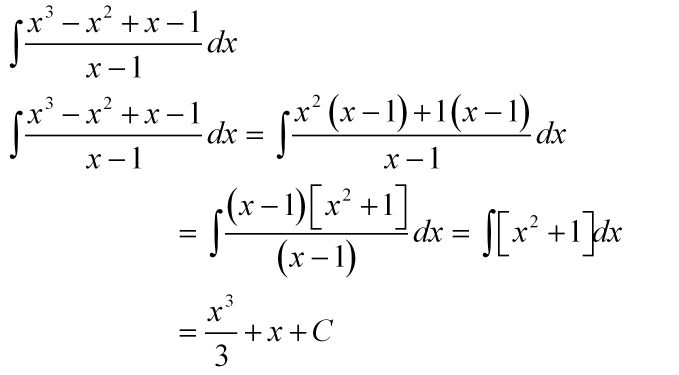
integral of [ x^3 - x^2 + x -1] / (x-1)

factorise the numerator

cancel off the common factor

use the integral of x^n to integrate term by term
go through the  integration formulae 


free guide on integration  or integral calculus for cbse isc kerala higher secondary class 12 ncert scert students


-----------------------------------------------------------

please leave your comments below

------------------------------------------------------------

index of math problems


disclaimer:

There is no guarantee about the data/information on this site. You use the data/information at your own risk. You use the advertisements displayed on this page at your own risk.We are not responsible for the content of external internet sites. Some of the links may not work


Friday, March 8, 2013

integral1


integral of (x^3 +3x +4) /sqrt(x)

since quotient rule is not used in integration you divide each term in the numerator with the denominator and
reduce every thing to x^n form and then integrate term by term
go through the  integration formulae 


free guide on integration  or integral calculus for cbse isc kerala higher secondary class 12 ncert scert students


-----------------------------------------------------------

please leave your comments below

------------------------------------------------------------

index of math problems


disclaimer:

There is no guarantee about the data/information on this site. You use the data/information at your own risk. You use the advertisements displayed on this page at your own risk.We are not responsible for the content of external internet sites. Some of the links may not work


Friday, October 23, 2009

uses of graph in solving equations

uses of graph in solving equations

solve (x^2)- 2x - 8 = 0 by graphing
solving a quadratic equation by graphing

graphical solution of system of two simultaneous linear equations in two unknowns
solve graphically 3x-7y+10=0 , 2x-y+3=0
graphical solution


-----------------------------------------------------------
please leave your comments below
------------------------------------------------------------
index of math problems


disclaimer:
There is no guarantee about the data/information on this site. You use the data/information at your own risk. You use the advertisements displayed on this page at your own risk.We are not responsible for the content of external internet sites. Some of the links may not work


Monday, August 3, 2009

collection of problems in integration, differentiation, areas, volumes, trigonometry, matrices, limits

Calculus
problems on integration ------------------------ integration

problems on application of integration like
area, volume, arc length etc ------------------------integration application

problems on differential equations ------differential equation

problems on differentiation------------------------ differentiation

problems on limits ------------------limits

problems on matrices --------------matrices

problems on trigonometry ------trigonometry


-----------------------------------------------------------
please leave your comments below
------------------------------------------------------------
index of math problems


disclaimer:
There is no guarantee about the data/information on this site. You use the data/information at your own risk. You use the advertisements displayed on this page at your own risk.We are not responsible for the content of external internet sites. Some of the links may not work


Tuesday, June 30, 2009

numerical problems in physics

Uniform motion
A vehicle accelerates from rest at a constant rate A m/s² for some time after which it decelerates at a constant rate B m/s² to come to rest. If the total time elapsed is T seconds, find the maximum velocity and the total distance travelled in terms of A,B, T explanation


-----------------------------------------------------------
please leave your comments below
------------------------------------------------------------
index of math problems


disclaimer:
There is no guarantee about the data/information on this site. You use the data/information at your own risk. You use the advertisements displayed on this page at your own risk.We are not responsible for the content of external internet sites. Some of the links may not work


Wednesday, May 6, 2009

integral of 1 / [a + bsinx + c cosx ]

Integral of 1 / [a + bsinx + c cosx ]

Integration formulae


---------------------------------------
you might then have to restort to completion of squares in some cases after the manipulation

Examples
* integral of 1 / (5+4cosx) with limits 0 to (pi/2)
integral of 1 / {5 + 4 cos x } with limits


PAGE 1 BASIC INTEGRATION
PAGE 2 INTEGRATION BY SUBSTITUTIONPAGE 3 INTEGRATION BY COMPLETION OF SQUARES
PAGE 4 INTEGRATION BY PARTS
PAGE 5 INTEGRATION BY MANIPULATION OF NUMERATOR IN TERMS OF DENOMINATOR


-----------------------------------------------------------
please leave your comments below
------------------------------------------------------------
index of math problems


disclaimer:
There is no guarantee about the data/information on this site. You use the data/information at your own risk. You use the advertisements displayed on this page at your own risk.We are not responsible for the content of external internet sites. Some of the links may not work


Thursday, April 30, 2009

manipulation of numerator in terms of the denominator

Integration by manipulation of numerator in terms of the denominator

Integration formulae

(px+q) / (ax² + bx +c) , (px+q) /sqrt(ax² + bx +c) ,

(px² + qx +r) /(ax² + bx +c) type

(psinx+qcosx ) / (a sinx + b cosx )

----------------------------------------------------------------------------
for
---------------------------------------
you might then have to restore to completion of squares in some cases after the manipulation
in some cases the manipulation can be done through inspection

Examples

* ∫ { (4x - 7) / (x² + x +1)} dx
integration of linear expression in numerator mixed with quadratic expression

* ∫ { cosx/ [ sinx +cosx] } dx
integral of [ cos x ] / [sin x + cos x ]

*not the above types but still an example of manupulating the angle in the numerator in terms of the angles in the denominator


integral of 1 / [cos(x+a)cos(x+b)]

*integral of { (cos x)^2 / [ (cos x)^2+ 4 (sin x)^2 ]  }
answer and a little explanation of integral of { (cos x)^2 / [ (cos x)^2+ 4 (sin x)^2 ]  }


PAGE 1 BASIC INTEGRATION

PAGE 2 INTEGRATION BY SUBSTITUTION 
PAGE 3 INTEGRATION BY COMPLETION OF SQUARES

PAGE 4 INTEGRATION BY PARTS

PAGE 5 INTEGRATION BY MANIPULATION OF NUMERATOR IN TERMS OF DENOMINATOR


-----------------------------------------------------------
please leave your comments below
------------------------------------------------------------
index of math problems


disclaimer:
There is no guarantee about the data/information on this site. You use the data/information at your own risk. You use the advertisements displayed on this page at your own risk.We are not responsible for the content of external internet sites. Some of the links may not work


integration of some products using by parts

Integration by parts

Integration formulae

If an integral is a product of the form uv

usually u is chosen so that successive derivatives of u will become zero after a finite number of steps
provided v has a nice integral or you can make the choice using ILATE rule
inverse , log, algebraic, trigonometric, exponential

for eg. for integral of [x² cosx]

u = x² , v = cosx

but for integral of [x² ln(x)] , you should make it into integral of [ ln(x) * x²]
so that u = ln(x) , v = x²

for integral of lnx, make it into integral of [lnx * 1] with u = lnx , v = 1

in some integrals, like integral of [ (e^x) cosx ], take the integral as I, apply integration by parts a couple of times or so, and then obtain the original integral I again, then rearrange and extract the value of I.

also note the type
here split into two integrals
use integration by parts once on integral of [f(x)exp(x)] taking f(x) as the first function
this will cancel off the integral of [f '(x)exp(x)] leaving you with exp(x) * f(x ) + C which is the required answer

Examples on integration by parts


* integral of ln(x)
answer and some explanation


*integral of arc(cosx)
answer and some explanation


* integral of { [ arcsin(sqrt(x)) - arccos(sqrt(x)) ] / [ arcsin(sqrt(x)) + arccos(sqrt(x))] }
explanation and answer to the integral using integration by parts is available here

*integral of [1 / (x^4)][sqrt( 1 + (x^2))][ log( 1 + (x^2)) - 2log( x)]
explanation and answer using substitution and then integration by parts is available here

*integral of  [e^2x]cos3x using integration by parts
explanation and answer of   integral of [e^2x]cos3x using integration by parts


PAGE 1 BASIC INTEGRATION
PAGE 2 INTEGRATION BY SUBSTITUTIONPAGE 3 INTEGRATION BY COMPLETION OF SQUARES
PAGE 4 INTEGRATION BY PARTS
PAGE 5 INTEGRATION BY MANIPULATION OF NUMERATOR IN TERMS OF DENOMINATOR


-----------------------------------------------------------
please leave your comments below
------------------------------------------------------------
index of math problems


disclaimer:
There is no guarantee about the data/information on this site. You use the data/information at your own risk. You use the advertisements displayed on this page at your own risk.We are not responsible for the content of external internet sites. Some of the links may not work


integration by completion of squares

Integration by completion of squares

Integration formulae

If an integral is of

sqrt(ax² + bx +c) , 1 /sqrt(ax² + bx +c) ,1 /(ax² + bx +c) type

first complete the square

ax² + bx +c = a[ x² + (b/a)x + (c/a) ] =a[ ( x +(b/2a) )² + (c/a) -(b²/4a²) ]

remember to make the coefficient of x² unity before starting
Examples on integration by completion of squares

* integral of [ 1 / (x² -x+1)]
integral using completion of squares method

*integral of 1 / sqrt[4 + 3x - x² ]
completion of squares inside a square root

PAGE 1 BASIC INTEGRATION
PAGE 2 INTEGRATION BY SUBSTITUTIONPAGE 3 INTEGRATION BY COMPLETION OF SQUARES
PAGE 4 INTEGRATION BY PARTS
PAGE 5 INTEGRATION BY MANIPULATION OF NUMERATOR IN TERMS OF DENOMINATOR


disclaimer:
There is no guarantee about the data/information on this site. You use the data/information at your own risk. You use the advertisements displayed on this page at your own risk.We are not responsible for the content of external internet sites. Some of the links may not work

Monday, April 27, 2009

exact vaue of sin(arctan(4/3)-arccos(12/13))

exact value of sin [arctan(4/3)-arccos(12/13)]

let A = arctan(4/3)
tanA = 4/3
draw a rough right triangle to get

sinA = 4/5 ; cosA = 3/5


let B = arccos(12/13)
as before cosB = 12/13 ; sinB = 5/13

now sin [arctan(4/3)-arccos(12/13)] = sin[A-B] = sinAcosB - cosAsinB trigonometric identities
=(4/5 )(12/13) - (3/5)(5/13) = 33 / 65


-----------------------------------------------------------
please leave your comments below
------------------------------------------------------------
index of math problems


disclaimer:
There is no guarantee about the data/information on this site. You use the data/information at your own risk. You use the advertisements displayed on this page at your own risk.We are not responsible for the content of external internet sites. Some of the links may not work


Friday, April 24, 2009

integration guide (certain topics)

free online guide to certain topics on integration for plus two, isc , cbse etc

First of all try to familiarize yourself with the formulae on integration and trigonometric identities
Basic Integration
you can integrate an expression term by term
that is you can break up an integral of sum or difference of two expressions into sum or difference of two integrals

but do not do that with a product or quotient of two functionsbut integral of 2f(x) can be expressed as 2 * integral of f(x) since "2" is a constantDefinite Integrals (Integrals with limits)
trying to write expressions in the form x^n
for eg.
cube root of x can be written as x^(1/3)
1 / (x
³) can be written as x^(-3)

if you know that the integral of f(x) is g(x) + C
then the integral of f(ax+b) will be ( 1/a ) g(ax+b) + C

you can divide the numerator term by term using the denominator but
not the other way.if the numerator is of higher degree than the denominator use long division

if you have a product of sine and/or cosine terms use trigonometric identities for sinAcosB etc to break them into sum or difference before integrating
you can use substitution methods or trigonometric identities
to evaluate integrals with powers of sine or cosines.


Examples on basic integration


integral of sin(5x)sin(8x)
answer and some explanation


 integral of (x^3 +3x +4) /sqrt(x)
answer and some explanation 

integral of [ x^3 - x^2 + x -1] / (x-1)
answer and some explanation

*integral of e^(2-3x) using limit of sums
answer of integral of e^(2-3x) using limit of sums

PAGE 1 BASIC INTEGRATION
PAGE 2 INTEGRATION BY SUBSTITUTION

 PAGE 3 INTEGRATION BY COMPLETION OF SQUARES
PAGE 4 INTEGRATION BY PARTS
PAGE 5 INTEGRATION BY MANIPULATION OF NUMERATOR IN TERMS OF DENOMINATOR

PAGE 6 INTEGRATION USING PARTIAL FRACTIONS
PAGE 7 INTEGRATION OF 1 / [ACOSX +BSINX +C]


-----------------------------------------------------------
please leave your comments below
------------------------------------------------------------
index of math problems


disclaimer:
There is no guarantee about the data/information on this site. You use the data/information at your own risk. You use the advertisements displayed on this page at your own risk.We are not responsible for the content of external internet sites. Some of the links may not work


Monday, February 23, 2009

proving a trigonometry identity

show that [( tanx -sinx ) / (2tanx) ] = sin² (x/2)
divide term by term and change
every thing in terms of sinx and cosx and
then use half angle formulae
use this link for trigonometric identities formulae
-----------------------------------------------------------
please leave your comments below
------------------------------------------------------------
index of math problems

trigonometric identities


disclaimer:
There is no guarantee about the data/information on this site. You use the data/information at your own risk. You use the advertisements displayed on this page at your own risk.We are not responsible for the content of external internet sites. Some of the links may not work


Wednesday, February 18, 2009

idempotent law in a boolean algebra

show that a + a = a in a boolean algebra

a = a + 0
= a + (a. a' )
= (a + a ). (a + a ' )
= (a + a ). 1
= (a + a )

therefore a + a = a
note that the dual is a . a = a

-----------------------------------------------------------
please leave your comments below
------------------------------------------------------------
index of math problems


disclaimer:
There is no guarantee about the data/information on this site. You use the data/information at your own risk. You use the advertisements displayed on this page at your own risk.We are not responsible for the content of external internet sites. Some of the links may not work


Learn Function Notation, Inputs and Outputs for Digital SAT Math

  Guide to Functions for Digital SAT Math, GCSE, IGCSE, ACT, and High School Mathematics Part 1 — Understanding Functions from First Princip...